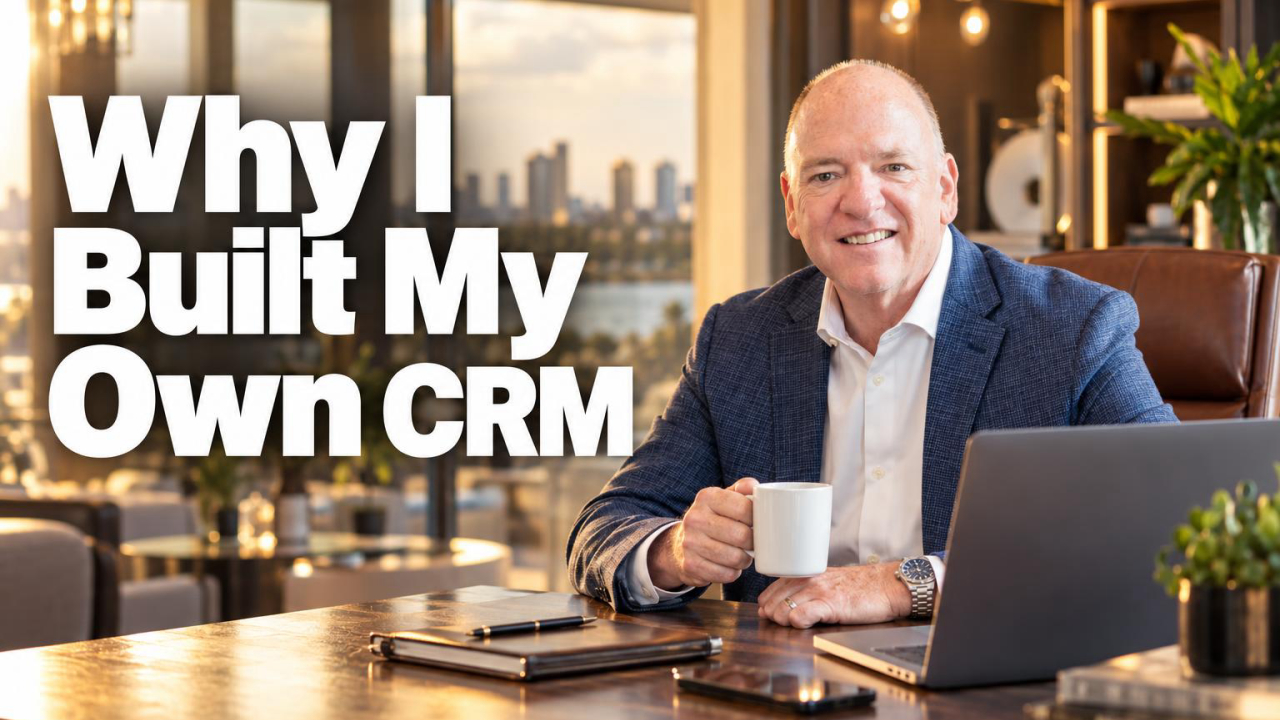
Why I Built My Own CRM Instead of Renting Someone Else's
🎙️ Listen: Buddy talks through this article · 6 min
An AI-produced audio version of this article, from Real Stories with Buddy Blake.
I want to give credit where it's due before I say anything else. My friend Mert Sahinoglu, who founded contentcodes.com, has been talking about something for a while now that I couldn't agree with more. I've been a customer of his and a friend for years, and the way he explains what's happening right now in tech and marketing is exactly right.
We're entering the dot-com boom all over again
Except this time, everyone thinks they're a software company.
AI has made building websites, apps, and internal tools so cheap and so fast that businesses are creating things they never would have attempted a few years ago. It reminds me a lot of the early days of the World Wide Web. Everyone needed a domain. Everyone needed a website. Everyone suddenly had an "Internet strategy."
Then building websites got easy. And simply having one stopped being an advantage.
I think we're about to watch the same thing happen with AI. Small businesses can now build websites, tools, automations, and even their own narrow software without a big development team or a big budget behind it. Which means being able to build something won't stay an advantage for very long. Mert's point, and mine, is that the real advantage will be knowing WHAT to build, owning the data that makes it better, controlling your own distribution, and solving a problem people will actually pay to have solved.
The dot-com boom taught us that owning a website wasn't the moat. The AI boom may teach us that owning software isn't one either. When everyone can build, the real advantage is knowing what's worth building.
Twenty-five years, and I finally built it my way
I've spent more than 25 years as a leader in tech marketing in this industry, going back to 1998 here in Wilmington. I've watched a lot of tools come and go. Most of them are built by companies that start out with real founder passion and eventually, because it's their job, move into pure profit mode. That's not a knock on them. It's just what happens.
What I wanted was different. I wanted a CRM and a consumer-facing site built my way, with my own ideas — no forced registration just to look at a home, and real home-owner intelligence reporting baked in, because helping sellers understand what's actually happening with their property is what I do. That's the whole reason I do this work.
I also wanted room for the things that matter to me personally — our mission, our statement of faith, the stuff that actually drives the business instead of sitting in a footer nobody reads. So I built buddyblake.ai on a brand new domain with zero authority behind it. No borrowed trust, no inherited traffic. Just a start.
What this actually means if you're selling a home
Here's where this stops being a tech story and starts being useful to you. Any tool I build is only worth something if it helps a seller make a better decision — pricing right, understanding what really happens to homes once they're listed, and knowing the difference between a listing that's marketed well and one that's just sitting on a portal hoping for the best.
That's the whole point of owning your own data instead of renting someone else's dashboard. I can build reporting that tells a homeowner in plain terms what's going on in their market, their neighborhood, their price range — not a generic national number that doesn't mean much locally. You can see that same thinking in how we lay out every neighborhood we track, or in our monthly market reports that try to tell the truth about what's moving and what isn't.
And if you want to see the whole region at once, every home for sale across the five counties is right there without anyone making you log in first.
The moat isn't the tool. It's the judgment.
I wrote a while back about the Zillow mortgage-steering lawsuit and what sellers should learn from it — the short version is that a portal can show you a house, but it can't tell you the truth about your specific situation. That's still true whether the portal is powered by 2015 technology or the newest AI model on the market. The software isn't the advantage. Knowing what to do with it is.
That's what I'm trying to build here. Not a flashier website. A better way for sellers to understand their own home's story, backed by 25-plus years of watching this market do exactly what it's doing now — except with better tools than I've ever had before.
If you want to talk about where your home stands right now, or you're just curious how this all fits together, give me a call or text at (910) 395-1000. I'd enjoy the conversation either way.
Read the episode transcript
Host: Okay, so today's episode is a little different — we're not talking about a specific listing or a neighborhood. We're talking about something Buddy's been building himself. Buddy, welcome back to the show.
Buddy Blake: Thanks for having me. Yeah, this one's a little more personal than usual. I built something, and I wanted to talk about why.
Host: Right, and before we even get into what you built, you told me there's someone you wanted to give credit to first. Who's that?
Buddy Blake: Yeah, my friend Mert Sahinoglu — he founded contentcodes.com. I've been a customer of his and a friend for years, and honestly, the way he explains what's happening right now in tech and marketing, he's just nailed it. So credit where it's due before I say anything else.
Host: Okay so what's he been saying that you agree with so much?
Buddy Blake: His point is that we're entering the dot-com boom all over again. Except this time everyone thinks they're a software company. AI has made building websites, apps, internal tools, so cheap and so fast that businesses are creating things they never would've attempted a few years ago.
Host: Huh, that's a really interesting way to put it. It does remind me of the early internet days — everybody needed a website, everybody had an 'internet strategy.'
Buddy Blake: Exactly that. Then building websites got easy, and just having one stopped being an advantage. I think we're about to watch the same thing happen with AI. Small businesses can build tools and automations and their own little pieces of software now, no big dev team, no big budget.
Host: So if everybody can build the thing... what actually separates people then?
Buddy Blake: That's Mert's point, and mine too — the real advantage is knowing WHAT to build. Owning the data that makes it better. Controlling your own distribution. And solving a problem people will actually pay to have solved. The dot-com boom taught us owning a website wasn't the moat. The AI boom might teach us owning software isn't one either.
Host: Okay so let's talk about you specifically then. You've been doing this a long time.
Buddy Blake: Twenty-five-plus years as a leader in tech marketing in this industry, going back to nineteen ninety-eight here in Wilmington. I've watched a lot of tools come and go. Most of them get built by companies with real founder passion, and eventually — because it's their job — they move into pure profit mode. That's not a knock on them, it's just what happens.
Host: But you wanted something different for yourself.
Buddy Blake: I did. I wanted a CRM and a consumer-facing site built my way. No forced registration just to look at a home — I hate that, honestly. And real home-owner intelligence reporting baked in, because helping sellers understand what's actually happening with their property, that's the whole reason I do this work.
Host: And I imagine there's stuff in there that's just... you. Not corporate boilerplate.
Buddy Blake: Yeah, exactly — room for the things that matter to me personally. Our mission, our statement of faith, the stuff that actually drives the business instead of sitting in a footer nobody reads. So I built buddyblake.ai on a brand new domain. Zero authority behind it, no borrowed trust, no inherited traffic. Just a start.
Host: Okay so let's get practical — if somebody's thinking about selling their home, what does any of this actually mean for them?
Buddy Blake: Here's where it stops being a tech story and starts being useful. Any tool I build is only worth something if it helps a seller make a better decision — pricing right, understanding what really happens to homes once they're listed, knowing the difference between a listing that's marketed well versus one that's just sitting on a portal hoping for the best.
Host: That's the whole reason to own your own data instead of renting somebody else's dashboard, right?
Buddy Blake: That's it exactly. I can build reporting that tells a homeowner in plain terms what's going on in their market, their neighborhood, their price range — not some generic national number that doesn't mean a thing locally. You can see that same thinking in how we lay out every neighborhood we track, and in our monthly market reports where we try to just tell the truth about what's moving and what isn't.
Host: And if somebody wants to just see everything at once, across the whole region?
Buddy Blake: Every home for sale across the five counties is right there. Nobody's making you log in first just to browse.
Host: You mentioned something a while back too — that Zillow mortgage-steering lawsuit. How does that connect to all this?
Buddy Blake: I wrote about that because it's a good example — a portal can show you a house, but it can't tell you the truth about your specific situation. And that's true whether the portal's running on old technology or the newest AI model out there. The software was never the advantage. Knowing what to do with it is.
Host: So when you say the moat isn't the tool, it's the judgment — that's really the whole thesis here.
Buddy Blake: That's what I'm trying to build. Not a flashier website. A better way for sellers to understand their own home's story, backed by twenty-five-plus years of watching this market do exactly what it's doing right now — just with better tools than I've ever had before.
Host: I really like that — it's not about the shiny new thing, it's about what you do with it. Buddy, this was a great conversation. Where should folks go if they want to talk through where their home stands, or just see how all this fits together?
Buddy Blake: Give me a call or text, nine-one-oh, three-nine-five, one-thousand. I'd enjoy the conversation either way. And the full article's linked in the show notes if you want to read it yourself.
Host: Perfect. Thanks so much for coming on and walking us through this, Buddy.
Buddy Blake: Anytime, thanks for having me.