
The Deal Killer Report: Why 1 in 5 Home Sales Fall Apart, and How a Pre-Inspection Keeps Yours Alive
🎙️ Listen: Buddy talks through this article · 9 min
An AI-produced audio version of this article, from Real Stories with Buddy Blake.
Here's something most sellers never hear until it happens to them: getting an offer isn't the finish line. Getting to the closing table is. And right now, across our five-county area, about 1 in 5 contracts on resale homes falls apart before it ever closes.
I've been selling homes here since 1998, and I've watched a lot of deals die. Almost always, it's for the same handful of reasons, and most of them could have been seen coming weeks before the house ever hit the market. So I built something to show it plainly, with real local numbers instead of opinions. We call it the Deal Killer Report.
What the Deal Killer Report Is
The Deal Killer Report tracks every resale home in our area that went under contract and then lost that contract. It doesn't matter whether the deal lasted three days or three months. If a buyer and seller agreed on a deal and it fell apart, it counts.
Then it follows each of those homes to see what happened next. Did it sell later? For how much? How long did it take? Is it still sitting on the market? Did it never sell at all? Finally, it compares all of that against the homes that sold on their first contract, so you can see the real difference between a deal that holds together and one that doesn't.
New construction and land are left out on purpose. Builder deals fall apart for different reasons, and I want this to be an honest picture of what happens when a regular homeowner sells.
How It Works and How It's Calculated
The numbers come straight from our MLS data, and the report rebuilds itself every six hours, so it's always current. Here's what it measures, in plain English:
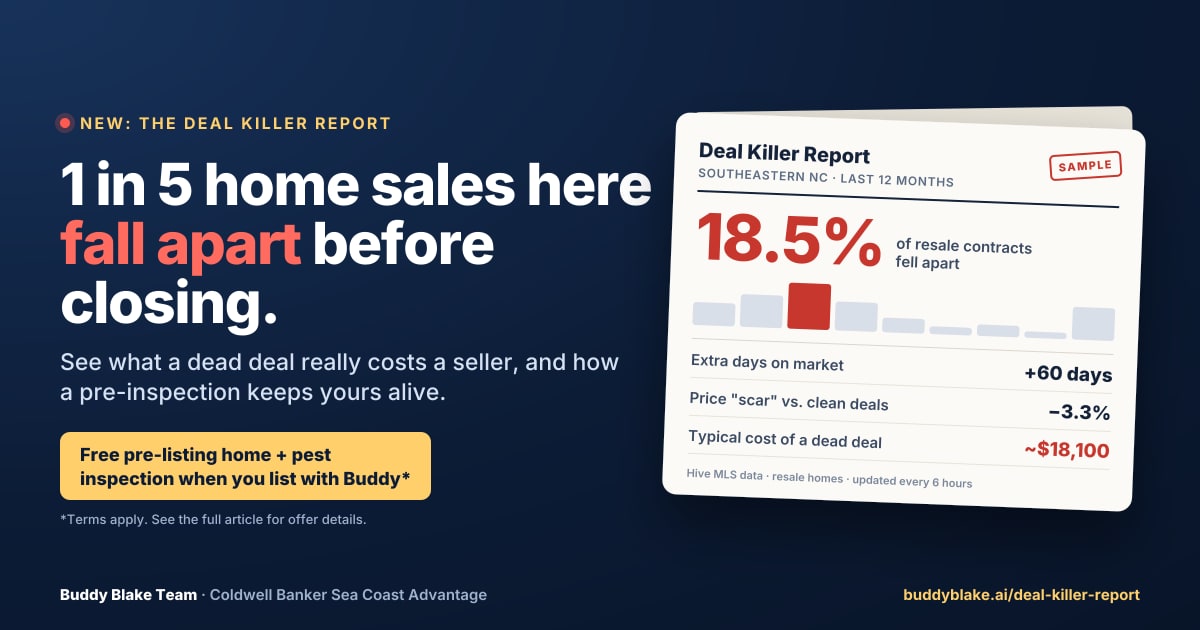
- The fall-through rate. Out of every resale contract written in the last 12 months, how many died. Right now that's 2,818 out of 15,208 contracts, or about 18.5%.
- Extra days on the market. Homes that sold on their first contract took a median of 28 days. Homes that lost a contract and sold later took a median of 88 days. That's about 60 extra days of carrying the house.
- The price "scar." Homes that sold clean brought about 97.3% of their original asking price. Homes that had a deal die brought about 94%. That 3.3-point gap is what I call the scar, because buyers see a home that came back on the market and start wondering what's wrong with it.
- The real dollar cost. The report takes the typical home price in the area (right now about $380,000) and adds up what those extra days cost you: mortgage interest at today's rates, property taxes, insurance, HOA dues, upkeep and utilities. That's roughly $93 a day. Sixty extra days is about $5,600. Add the price scar of about $12,500, and a dead deal costs a typical seller here roughly $18,100.
It also shows what sellers do after a deal dies. About 36% of them end up cutting their price, usually by around 6%. And of the homes that lost a contract and have since either sold or come off the market, more than 1 in 5 never sold at all.
You can break all of this down by county, town, zip code and larger neighborhoods on the Deal Killer Report page, and look at it by the age of the home, the type of foundation, and the price range.
What the Numbers Say About Older Homes and Crawl Spaces
This part surprised even me. Age and construction matter a lot:
- Homes under 10 years old lose about 14% of their contracts. Homes 50 years or older lose about 25%, or roughly 1 in 4.
- Homes on a crawl space lose about 22.5% of their contracts, compared to about 16% for homes on a slab or other foundation.
That lines up with what I see every week. The things that kill deals usually live in places nobody looks until the buyer's inspector crawls under the house or climbs into the attic: moisture, wood rot, termite damage, an aging roof, old wiring, a tired HVAC system. By the time the seller finds out, the buyer is scared, the clock is ticking, and the seller is negotiating from the weakest spot they'll be in during the whole sale.
Why a Pre-Inspection Matters More Right Now Than Ever
A few years ago, buyers were waiving inspections and overlooking almost anything to get a house. That market is gone. Today buyers have more choices, more time, and less patience for surprises. If something comes up in their inspection, many of them would rather walk and go look at the next house than fight through repairs.
A pre-inspection flips that around. Instead of the buyer finding the problem three weeks into the contract, you find it before you ever list. Then you get to decide what to do about it, on your schedule:
- Fix it before buyers ever see it, with your own contractor at your own price.
- Price for it honestly, so a buyer can't use it to renegotiate later.
- Disclose it up front, so it's already part of the deal instead of a surprise that blows it up.
Here's what that really buys you. You control the timeline instead of the buyer's inspector controlling it. You avoid weeks of extra carrying costs and the price scar that follows a dead deal. And maybe most important, you take a lot of the frustration and anxiety out of selling. Sellers tell me the waiting is the worst part, wondering every day whether the deal is going to hold. When the surprises are already off the table, you can sleep at night.
Why I'm Now Paying for Your Pre-Home and Pest Inspection
I believe in this so much that when you list your home with me, I'm now including a full pre-listing home inspection and a termite and pest (wood-destroying insect) inspection, and I pay for both upfront. (Offer terms are at the end of this post.)
I use a home inspector I've known and trusted for years. His reports are thorough and easy to read, he really knows the homes in our area, and he's willing to sit down and talk you through the report so you understand what matters and what doesn't. Not every item on an inspection report is a deal killer, and having someone explain the difference calmly makes all the difference.
My promise is simple. The inspection will be thorough, it will be fair, and we'll be transparent about what it finds. Then we'll make a plan together to fix, price or disclose each item, so the deal we write has the best possible chance of making it all the way to closing.
It's part of how my team sells homes. You can read more about our whole approach on how we sell homes.
See the Numbers for Your Area
Every area is a little different, and the numbers change as the market moves. Pull up the Deal Killer Report to see what dead deals are costing sellers in your county, town or neighborhood. You can also check Market Insights to see how many homes in your area sell at all versus expire or get pulled off the market.
If you're thinking about selling in the next year, let's talk before you list. I'll show you the numbers for your neighborhood, get your inspections on the calendar, and help you sell with a lot less stress. Call or text me at (910) 395-1000.
Offer terms: The pre-listing home inspection and termite/pest inspection paid for by Buddy Blake are available only when your home is listed with Buddy Blake of the Buddy Blake Team, Coldwell Banker Sea Coast Advantage, at the full listing commission fee, and when no referral fee is due to another agent or an online company (for example Zillow, Realtor.com or Homes for Heroes). Any compensation offered to a buyer's agent is up to the seller to choose and/or negotiate.
Read the episode transcript
Host: So Buddy, I gotta start with this line from your report because it stopped me cold — getting an offer isn't the finish line, getting to the closing table is. And right now, about one in five contracts on resale homes in our area falls apart before it closes. One in five?
Buddy Blake: Yeah, it's a gut punch when you say it out loud, right? I've been selling homes here since nineteen ninety-eight, and I've watched a lot of deals die. And almost every time, it's the same handful of reasons. Most of them could've been spotted weeks before the house even hit the market. So I built something to show it plainly, with real local numbers instead of just my opinion. We call it the Deal Killer Report.
Host: Okay, break that down for me. What exactly does this report track?
Buddy Blake: So it tracks every resale home in our five-county area that went under contract and then lost that contract. Didn't matter if the deal lasted three days or three months — buyer and seller agreed, and then it fell apart, it counts. Then we follow that home. Did it sell later? For how much? How long did it take? Is it still just sitting there? Did it never sell at all? And then we compare all of that to homes that sold clean on the first contract.
Host: And I noticed you leave out new construction and land on purpose.
Buddy Blake: Right, builder deals fall apart for totally different reasons. I wanted this to be an honest picture of what happens when a regular homeowner sells their home.
Host: So how often does this actually get updated? Because real estate moves fast.
Buddy Blake: It pulls straight from our MLS data and it rebuilds itself every six hours. So it's always current, it's not some stale number from a report somebody ran months ago.
Host: Okay, so give me the actual fall-through rate.
Buddy Blake: Out of every resale contract written in the last twelve months, two thousand eight hundred eighteen out of fifteen thousand two hundred eight died. That's about eighteen and a half percent.
Host: And what does that actually cost somebody in terms of time? Like, days on market?
Buddy Blake: This is where it gets real. Homes that sold on their first contract, median of twenty-eight days. Homes that lost a contract and sold later, median of eighty-eight days. That's about sixty extra days of carrying that house.
Host: Sixty days. And I imagine that's not just annoying, it costs money.
Buddy Blake: Oh, it costs money two different ways. First there's what I call the price scar. Homes that sold clean brought about ninety-seven point three percent of their original asking price. Homes that had a deal die brought about ninety-four percent. That three point three point gap, that's the scar, because buyers see a home come back on the market and they start wondering what's wrong with it.
Host: Even if nothing's actually wrong.
Buddy Blake: Even if nothing's wrong, that's the frustrating part. And then there's the carrying cost. We take the typical home price around here, about three hundred eighty thousand dollars, and add up the mortgage interest, property taxes, insurance, HOA dues, upkeep, utilities. Comes out to roughly ninety-three dollars a day. Sixty extra days is about fifty-six hundred dollars. Add the price scar of about twelve thousand five hundred dollars, and a dead deal costs a typical seller here roughly eighteen thousand one hundred dollars.
Host: Eighteen thousand dollars. That's not a small number.
Buddy Blake: No it's not. And here's the other thing the report shows — about thirty-six percent of sellers end up cutting their price after a deal dies, usually by around six percent. And of the homes that lost a contract and have since either sold or come off the market, more than one in five never sold at all.
Host: Wow. Okay, so let's talk about what's actually killing these deals. You mentioned older homes and crawl spaces — what did the numbers show?
Buddy Blake: This part surprised even me, honestly. Homes under ten years old lose about fourteen percent of their contracts. Homes fifty years or older lose about twenty-five percent — that's roughly one in four. And homes on a crawl space lose about twenty-two and a half percent of their contracts, compared to about sixteen percent for homes on a slab.
Host: So it's really about what's hiding in the house that nobody's looked at yet.
Buddy Blake: Exactly. The stuff that kills deals usually lives in places nobody checks until the buyer's inspector crawls under the house or gets up in the attic. Moisture, wood rot, termite damage, an aging roof, old wiring, a tired HVAC. And by the time the seller finds out, the buyer's scared, the clock's ticking, and the seller is negotiating from the weakest spot they'll be in the whole sale.
Host: Okay so this is where the pre-inspection comes in, right? Why does that matter more now than it used to?
Buddy Blake: A few years ago buyers were waiving inspections just to get a house, overlooking almost anything. That market's gone. Today buyers have more choices, more time, and a lot less patience for surprises. If something comes up in their inspection, a lot of them would rather just walk and go look at the next house than fight through repairs.
Host: So a pre-inspection flips who finds the problem first.
Buddy Blake: That's exactly it. Instead of the buyer finding the problem three weeks into the contract, you find it before you ever list. Then you decide what to do about it, on your own schedule. Fix it with your own contractor at your own price. Price for it honestly so a buyer can't use it to renegotiate later. Or disclose it up front so it's already part of the deal instead of a surprise that blows the whole thing up.
Host: I love that framing — you control the timeline instead of the buyer's inspector controlling it.
Buddy Blake: That's the real win. You avoid the extra carrying costs, you avoid that price scar. And honestly, maybe the biggest thing — it takes a lot of the anxiety out of selling. Sellers tell me the waiting is the worst part, wondering every single day if the deal's gonna hold. When the surprises are already off the table, you can actually sleep at night.
Host: So you believe in this enough that you're actually doing something about it now, right?
Buddy Blake: Yeah, I believe in it so much that when you list your home with me, I'm including a full pre-listing home inspection and a termite and pest inspection, and I pay for both of those upfront. I use an inspector I've known and trusted for years — his reports are thorough, easy to read, he knows the homes in our area, and he'll actually sit down with you and walk through the report so you understand what matters and what doesn't.
Host: That last part feels important. Not every item on an inspection is a dealbreaker.
Buddy Blake: Not even close. That's why having someone explain the difference calmly makes all the difference. My promise is simple — it'll be thorough, it'll be fair, and we'll be transparent about what it finds. Then we make a plan together, fix it, price for it, or disclose it, so the deal we write has the best shot of making it all the way to the closing table.
Host: And for folks listening who wanna actually see these numbers for their own neighborhood?
Buddy Blake: The Deal Killer Report breaks it all down by county, by town, by zip code, even by the age of the home and the foundation type. We've got it linked in the show notes for you. Every area's a little different, and the market moves, so it's worth pulling up and seeing what dead deals are costing sellers right where you live.
Host: This has been such a good one, Buddy. Any last thing you want sellers to walk away with?
Buddy Blake: Just this — if you're thinking about selling in the next year, let's talk before you list. I'll show you the numbers for your neighborhood, get your inspections on the calendar, and help you sell with a lot less stress. Call or text me, nine one zero, three nine five, one zero zero zero.
Host: Nine one zero, three nine five, one zero zero zero. And the full article and the Deal Killer Report are linked in the show notes so you can look up your own area. Buddy, thanks so much for walking through all this.
Buddy Blake: Thanks for having me.