
Did You Know? 1 in 4 New Hanover County Listings Never Sold

🎙️ Listen: Buddy talks through this article · 8 min
An AI-produced audio version of this article, from Real Stories with Buddy Blake.
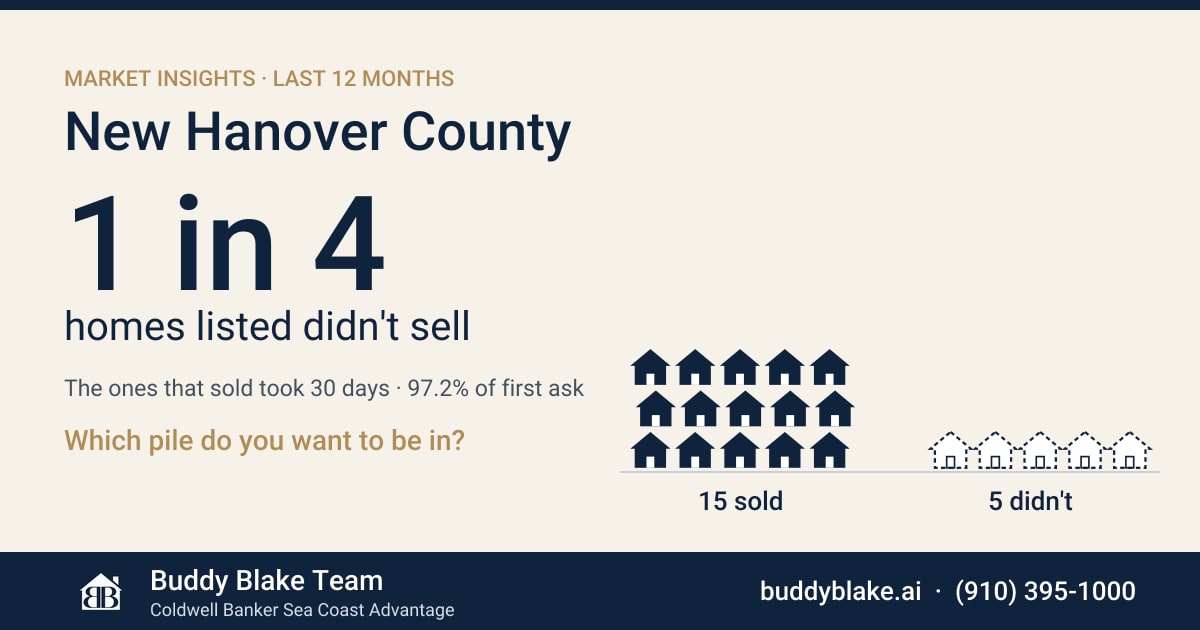
Here's one that stops people mid-sentence when I tell them: over the last 12 months, 1 in 4 homes listed in New Hanover County never sold. They expired, got withdrawn, or got canceled. That's not a small slice of the market. That's a quarter of it.
New Hanover County by the numbers
| Homes that finished on the market (12 months) | 5,638 |
| Sold | 4,183 |
| Didn't sell (expired, withdrawn or canceled) | 1,455 (26%) |
| Typical days to sell, from first listed | 30 days |
| Sold vs. first asking price | 97.2% |
| Priced right from day one: typical days to sell | 10 days |
| Needed price cuts: typical days to sell | 69 days |
| Contracts that fell apart before closing | 15% |
| Estimated monthly cost to hold a typical home | $3,510 |
Source: Hive MLS data compiled by the Buddy Blake Team, last 12 months. See the full New Hanover County report or download the printable PDF there.
Why So Many Homes Don't Sell Here
Price range matters a lot. In the $1M+ range, 34% of listings didn't sell. In the $400,000 to $500,000 range, that number drops to 21%. Same county, same market conditions, very different outcomes depending on where a home is priced.
But price range isn't the whole story. Pricing strategy is the bigger one. Homes that were priced right from the start typically sold in 10 days — and there were 2,159 of them. Homes that needed a price cut along the way took a median 69 days to sell, and 2,024 homes fell into that group. They still sold, but at a lower typical percentage of asking, 93.0%, compared to homes that never needed a cut.
And then there's the group that never sold at all. Those listings sat a median 131 days before coming off the market, and even then, the typical price cut was only 2.1%. In other words, a lot of these homes weren't priced way off — they were just priced a little too high for a little too long, and that's often enough to keep a house sitting.
What Waiting Costs
Let's put real numbers on it. At a median sold price of $469,000 and today's mortgage rate of 7.03%, the estimated monthly carrying cost on that home runs about $3,510. That's the mortgage payment reality a buyer is working with — and it's also the clock a seller is running against every month a home sits.
Now stretch that out. A home that sits unsold instead of selling quickly can add up to roughly $15,100 in carrying costs. That's not a fee anyone charges you. That's just the math of holding a house — payments, insurance, taxes, upkeep — while it waits for the right offer. Pricing right from day one isn't just about speed. It's about what stays in your pocket.
Why Contracts Fall Apart — and How to Prepare
Separate from listings that never sold at all, 15% of accepted contracts in New Hanover County fell apart before closing — about 1 in 6. The MLS doesn't record the reason a contract falls through, but in my experience, it's most often inspection, appraisal, or financing.
Here's the part worth knowing: of the homes where the first contract fell through, 65% went on to sell later, at a typical 94.1% of asking, but it took a median 78 days to get there. Another 32% never sold at all after that first contract collapsed. Compare that to homes where the first contract held — those typically sold at 97.5% of asking in just 25 days. The first contract mattering that much is exactly why getting ahead of inspection and financing surprises before you list is worth the effort.
This is a big part of why I have my sellers do a pre-market inspection before we ever put a sign in the yard. You want to know what an inspector is going to find before a buyer's inspector finds it for you. You can read more about how we set that up at /sell.
What It Means for Buyers
If you're house hunting in New Hanover County, it helps to know how other buyers are actually paying for these homes. Over the last 12 months, 26% of buyers paid cash, 58% used conventional financing, 5% used VA loans, and 5% used FHA loans. Financing type matters when you're structuring an offer, especially in a market where 15% of contracts don't make it to closing.
If you want help finding a home and putting together an offer that's built to hold up through inspection and appraisal, my team works with buyers every day. You can start at /buy.
There's a lot more in the full New Hanover County report, including how these numbers break down by price range and property type. You can dig into it at /market-insights/new-hanover-county. And if you've got a house you're thinking about selling, or you're wondering what any of this means for your specific situation, give me a call or text at (910) 395-1000. Happy to talk it through.
Read the episode transcript
Host: Okay, so I gotta be honest, when you first told me this stat I actually made you repeat it. Welcome back to Real Stories with Buddy Blake, I'm here with Buddy, and today we're talking about something that I think a lot of sellers just... don't realize is happening in New Hanover County.
Buddy Blake: Yeah, this is the one that stops people mid-sentence every time I bring it up. Over the last twelve months, one in four homes listed in New Hanover County never sold. They expired, they got withdrawn, or they got canceled. That's not a small slice of the market. That's a quarter of it.
Host: A quarter! Okay wait, walk me through the actual numbers, because I feel like people hear 'one in four' and think, eh, that sounds made up. What's the real breakdown?
Buddy Blake: It's not made up, unfortunately. Fifty-six hundred and thirty-eight homes finished on the market in that stretch. Forty-one eighty-three of them sold. And fourteen fifty-five — that's the twenty-six percent — didn't. Now the ones that did sell, typical time was thirty days from first listed, and they sold for about ninety-seven point two percent of asking. So the market's healthy, it's just... it's not automatic.
Host: Right, it's not like every house just sells eventually. Okay so what actually separates the homes that sold from the ones that just sat there?
Buddy Blake: Honestly, it comes down to pricing strategy more than anything. Homes that were priced right from day one — typically sold in ten days. There were twenty-one fifty-nine of those. But homes that needed a price cut along the way? Median of sixty-nine days to sell, and they landed at ninety-three percent of asking instead of the higher number. Twenty-oh-twenty-four homes fell into that group.
Host: So even the ones that eventually sold after a price cut, they left money on the table basically.
Buddy Blake: Exactly. Ten days versus sixty-nine days, and a few points off the sale price. That adds up fast.
Host: Okay so does price range play into this too? Like, does it matter if you're selling a starter home versus something bigger?
Buddy Blake: It matters a lot, actually. In the million-dollar-plus range, thirty-four percent of listings didn't sell. Compare that to the four-hundred-to-five-hundred-thousand range, where it's twenty-one percent. Same county, same market conditions, really different outcomes just based on where a home's priced.
Host: Huh. So the higher up you go, the harder it gets.
Buddy Blake: Right, but here's the thing — price range isn't the whole story. Pricing strategy is the bigger factor. And look at the homes that never sold at all — they sat a median of a hundred and thirty-one days before coming off the market. And even then, the typical price cut was only two point one percent.
Host: Wait, only two percent? So these weren't wildly overpriced homes.
Buddy Blake: That's exactly it. A lot of these homes weren't priced way off. They were just priced a little too high for a little too long. And that's often enough to keep a house sitting on the market.
Host: Okay, so let's talk real dollars here, because 'sitting on the market' sounds annoying but what does it actually cost someone?
Buddy Blake: So at a median sold price of four sixty-nine thousand, and today's mortgage rate around seven point oh three percent, the estimated monthly carrying cost on that home runs about thirty-five hundred and ten dollars. That's the payment reality a buyer's working with, but it's also the clock a seller's running against every single month the home sits.
Host: And that's not like, a fee you're paying somebody. That's just... the house existing.
Buddy Blake: Right, exactly. It's the mortgage, insurance, taxes, upkeep. Now stretch that out — a home that sits unsold instead of selling quickly can add up to roughly fifteen thousand one hundred dollars in carrying costs. Pricing right from day one isn't just about speed. It's about what stays in your pocket at the end.
Host: Okay that number, fifteen thousand, that's real money. Alright, let's shift gears — you mentioned contracts falling apart. That's a different problem than a listing never selling, right?
Buddy Blake: Totally different. So separate from the homes that never sold at all, fifteen percent of accepted contracts in the county fell apart before closing — about one in six. The MLS doesn't tell you why, but in my experience it's almost always inspection, appraisal, or financing.
Host: One in six! Okay so if a contract falls through, is that home basically doomed, or does it usually still sell eventually?
Buddy Blake: It's mixed. Of the homes where that first contract fell through, sixty-five percent went on to sell later — typically at ninety-four point one percent of asking, but it took a median of seventy-eight days to get there. The other thirty-two percent never sold at all after that. Compare that to homes where the first contract held — those sold at ninety-seven point five percent of asking in just twenty-five days.
Host: Wow, so that first contract really matters. Like, a lot.
Buddy Blake: It really does. And that's exactly why I have my sellers do a pre-market inspection before we ever put a sign in the yard. You want to know what an inspector's gonna find before a buyer's inspector finds it for you.
Host: That makes so much sense, get ahead of the surprises instead of getting hit by them mid-contract. Okay, last thing — what about buyers? How's everybody actually paying for these homes right now?
Buddy Blake: Good question. Over the last twelve months, twenty-six percent of buyers paid cash, fifty-eight percent used conventional financing, five percent used VA loans, and five percent used FHA loans. Financing type matters a lot when you're putting an offer together, especially in a market where fifteen percent of contracts don't make it to closing.
Host: So it's not just about the price you offer, it's about how solid that offer actually is.
Buddy Blake: Exactly right. A strong price with shaky financing can fall apart just as easy as a weak offer.
Host: This was such a good breakdown, Buddy. Honestly, the one-in-four stat alone is gonna stick with me. Any last thing you want folks to know?
Buddy Blake: Just that there's a lot more in the full New Hanover County report — how these numbers break down by price range and property type, all of it. We've got that linked in the show notes for you. And if you've got a house you're thinking about selling, or you're just wondering what any of this means for your situation, give me a call or text, nine-one-oh, three-nine-five, one-thousand. Happy to talk it through.
Host: Love it. Thanks so much for breaking this down, Buddy — and to everyone listening, check the show notes for that full report. We'll catch you next time on Real Stories with Buddy Blake.