Why the Traditional New Agent Model Is Failing — And the Team-Centric Fix That Could Save the Industry
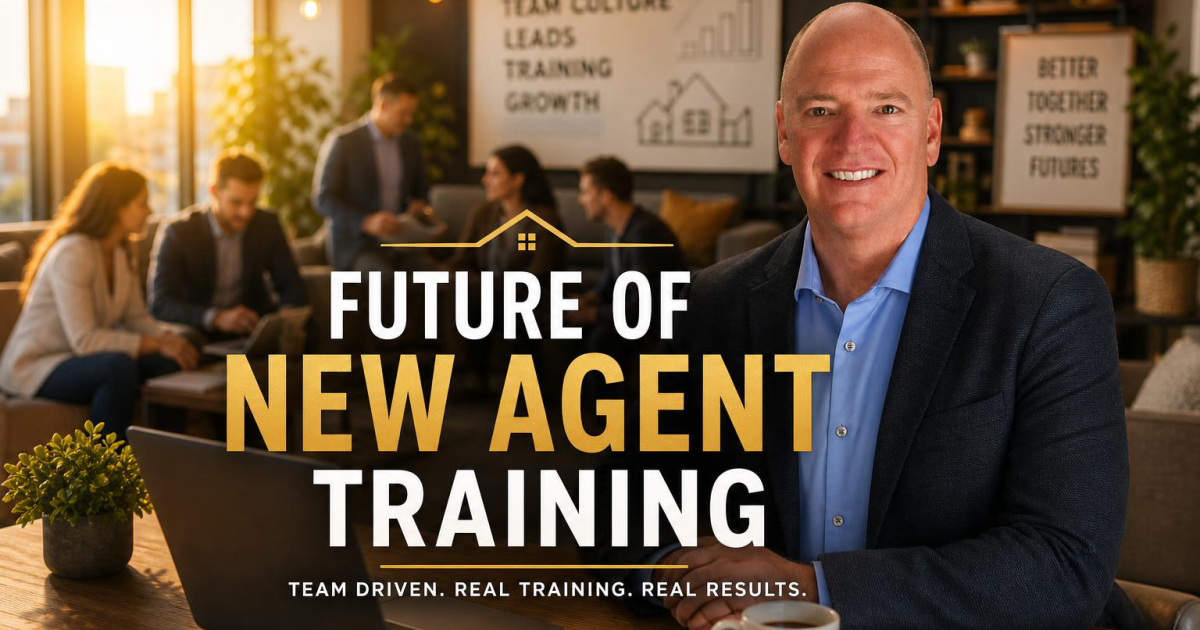
I was in a meeting recently — a room full of brand new agents, fairly new agents, and some experienced pros who had come up through teams — and we had one of the most honest, productive conversations I've had in years about what's actually broken in this industry. The topic: why do so many new real estate agents fail, and what could we actually do differently? What came out of that conversation wasn't just frustration with the status quo. It was the beginning of a real model — one that I think some forward-thinking company is eventually going to implement, and when they do, it's going to reshape how this industry brings new talent into the business. Let me walk you through exactly what we talked about and why I think the stakes couldn't be higher.
- Traditional brokerage onboarding models are not adequately preparing new agents for today's hyper-competitive real estate market.
- A company-sponsored team placement model — with subsidized leads, mentorship fees, and a "Team Fair" matching process — could dramatically reduce the 87% new agent failure rate.
- Ancillary service partners (mortgage, title, insurance) can legally co-invest in lead generation to fuel this model under RESPA guidelines.
- New agents need real-world sales training — not just platforms and book learning — to develop the skills and resilience to survive.
- Accountability culture is the missing ingredient in most team models, and it's what separates agents who make it from those who don't.
- In the Wilmington, NC market specifically, joining the right team is the single highest-leverage decision a new agent can make.
The Traditional New Agent Model Is Broken
Let me be clear upfront: this is not a slant on any particular company. Every major brokerage has built its model thoughtfully, and those models are working quite well — for the company. They're making money. Their systems are functioning as designed. The problem isn't malice or negligence. The problem is that the model was designed for a different era of real estate, and the world has changed dramatically around it.
The traditional onboarding sequence goes something like this: a new agent gets licensed, joins a brokerage, goes through training on paperwork, technology, compliance, and documents, and then gets sent out into the world with the advice to do open houses, talk to their sphere of influence, and add people to their database. That's it. That's the launch plan. And for a long time, in a less competitive market, that actually worked for a meaningful percentage of new agents.
According to the National Association of Realtors, approximately 87% of new real estate agents fail within their first five years. That number hasn't been improving — it's been getting worse. And the reason is straightforward: the competitive landscape has fundamentally shifted, but the onboarding model hasn't kept pace. New agents are being trained for a market that no longer exists and then released into one that's almost unrecognizable by comparison.
Real estate schools and formal training do what they're designed to do — they teach new agents how to fill out documents correctly, how to describe agency relationships, how to navigate the legal framework of a transaction. That's genuinely important knowledge. But here's the painful truth: if you never get in front of a customer, you don't need that knowledge yet. The training is, to some degree, backwards from what it should be in today's world. You're teaching someone to swim on a whiteboard, and then throwing them into the deep end of the ocean alone.
What's missing isn't knowledge of forms or technology platforms. What's missing is real-world sales training, genuine mentorship, and a consistent flow of leads to work. Those three things are what determine whether a new agent survives their first year — and right now, most brokerages aren't providing any of them in a meaningful, structured way.
The good news is that the solution isn't complicated to conceptualize. It requires a shift in how brokerages think about their responsibility to new agents — from "we provide tools and training, the rest is on you" to "we are invested in your success because your success is our success." That shift in mindset is the foundation of everything I'm proposing here. You can explore what a truly agent-first approach looks like at Buddy Blake Real Estate.
What New Agents Are Actually Competing Against in 2026 and Beyond
Here's what nobody tells new agents clearly enough before they get their license: you are not just competing with other individual agents anymore. That competition is the least of your problems. You are competing with high-tech teams that employ inside sales agents, predictive analytics tools, AI-driven lead nurturing systems, and dedicated transaction coordinators. You are competing with teamerages — brokerages that are essentially structured like teams — that have millions of dollars in marketing infrastructure behind them.
And then there's the platform competition. Zillow Flex, Realtor.com, HomeLight, OpCity, and dozens of other referral portals are all actively vying for the same buyer or seller at the exact moment that person is ready to make a move. These platforms spend hundreds of millions of dollars per year on digital advertising to capture leads at the most critical decision-making moments — and then they sell those leads back to agents at a premium, or route them to their own preferred agent networks. A new agent with a limited budget and no established digital presence simply cannot compete with that infrastructure on their own.
The cost of leads has escalated dramatically. Depending on the platform and market, buyer leads can cost anywhere from $20 to $220 per lead, and conversion rates on cold leads average around 1–3% industry-wide. That means a new agent might spend $2,000 to $5,000 just to generate one transaction from purchased leads — before accounting for their split, their marketing costs, their MLS dues, and their errors and omissions insurance. Most new agents simply don't have that kind of financial runway.
What most new agents do have is time, energy, and a willingness to do uncomfortable things to get their business going. The problem is that those assets — which are genuinely valuable — are being deployed inefficiently. Sending a new agent to work their sphere of influence sounds reasonable in theory, but in practice, most new agents' spheres aren't large enough or warm enough to generate consistent transaction volume in year one. And the discomfort of cold prospecting without a system, without scripts, without a coach listening to your calls and giving you real-time feedback? That's where most people quit.
In markets like Wilmington's most competitive neighborhoods, the gap between what a well-resourced team can do and what a solo new agent can do is enormous. Teams in this market are running CRM systems with thousands of contacts, doing consistent database marketing, running paid social and search campaigns, and following up on leads with speed-to-lead systems that respond in under five minutes. A new agent checking their email once a day simply cannot compete with that response infrastructure.
The Company-Sponsored Team Placement Model Explained
Here's the idea that came out of our conversation, and I think it's genuinely transformative: some company — whether at the corporate level, the regional level, or even at the office level — is going to move into a mode where they require new agents to go through company-sponsored teams. Not optional. Required. And that requirement, combined with the right financial structure, could be the single biggest shift in new agent success rates the industry has seen in decades.
Here's what this model looks like in practice. The brokerage identifies and pre-approves a roster of team leaders within their company — teams that have demonstrated lead generation capability, a defined culture, a training methodology, and a track record of agent success. The brokerage then subsidizes those team leaders to offset the cost of bringing new agents onto their team, including the cost of generating leads for those new agents to work.
The goal for a new agent placed in this model would be a consistent flow of 20 to 30 real leads per month — not recycled database contacts, but actual new leads generated through the team's marketing infrastructure. That's enough volume for a new agent to get real reps, develop real skills, and build real momentum in their first year. Compare that to the current model where a new agent might go weeks without a single meaningful client interaction.
This model also works for solo agents who are growing their business and could genuinely use showing help or administrative support. A high-producing solo agent in a market like Wilmington who is doing 30+ transactions a year but hasn't built a formal team could participate in this program — they get a new agent to help with showings and follow-up, and the new agent gets mentorship and deal exposure. Both parties win.
The training component in this model goes far beyond what any platform delivers. Yes, there are excellent systems out there — Ninja Selling, Floyd Wickman, Buffini & Company, Tom Ferry — and they all have genuine value. But the real world is hearing the conversations, doing the conversations, making the phone calls, and sitting across from a real buyer or seller and navigating what comes up in that moment. That experience cannot be replicated in a classroom or on a webinar. It only comes from repetition in real situations with a mentor nearby to debrief afterward.
I've seen this model work firsthand. When I got into the business, there was a rudimentary mentorship program where I was paired with an experienced agent and paid that agent a percentage of my income for my first six transactions. That structure worked well. I learned the idiosyncrasies of the business — the things you simply cannot teach from a book. The nuances of how a negotiation actually unfolds, how to handle a seller who gets cold feet two days before closing, how to manage a buyer who falls in love with a house that's wrong for them. Those lessons came from being in the room, not from reading about it.
How Ancillary Service Partners Could Legally Fuel the Lead Engine
One of the most compelling — and underutilized — aspects of this model is the role that ancillary service partners could play in funding the lead generation engine. Brokerages that have in-house or affiliated mortgage, title, and insurance operations have a natural financial alignment with every successful transaction. The more transactions that close, the more business those ancillary services capture. That alignment creates a legitimate, legal basis for those partners to co-invest in marketing and lead generation under RESPA guidelines.
To be crystal clear: this has to be done by the rules. RESPA (the Real Estate Settlement Procedures Act) governs how settlement service providers can and cannot share fees and marketing costs. But there are compliant structures — affiliated business arrangements (AfBAs), legitimate marketing service agreements, and co-marketing programs — that allow these partners to participate in marketing spend in ways that benefit all parties. The key is that the arrangement must be transparent, disclosed, and structured around actual marketing services rendered, not kickbacks for referrals.
Think about what this looks like in practice. A mortgage partner like Joey Milam at Alpha Mortgage has a direct financial interest in every buyer that successfully closes a transaction. If co-investing in a marketing campaign that generates 30 leads per month for a team of new agents results in five additional closings per month, that's five additional loan originations. The math makes sense for the mortgage partner to participate in that marketing cost — legally, transparently, and in a way that creates genuine value for the consumer.
The same logic applies to insurance partners. A relationship with someone like Tyler Beverage at My Carolinas Insurance creates a natural co-marketing opportunity. Every homebuyer needs homeowners insurance. Every transaction that closes is a potential insurance client. When ancillary partners are integrated into the team model from day one — introduced to clients early in the process and positioned as trusted resources — everyone benefits: the client gets a more seamless experience, the ancillary partner gets a warm introduction, and the team gets marketing cost support.
This is genuinely one of the most underexplored opportunities in the brokerage model. Large companies with affiliated services are leaving significant marketing leverage on the table by not formalizing these co-investment structures. The brokerages that figure out how to do this compliantly and at scale will have a substantial competitive advantage in recruiting, lead generation, and new agent retention.
The Team Fair Concept — Matching New Agents to the Right Culture
Here's one of the ideas from our conversation that I find genuinely exciting: the Team Fair. Larger brokerages are going to have multiple approved teams, each with their own methodology, culture, lead generation approach, and daily operating rhythm. Why not let new agents choose which team they join the same way college students choose their major — through an informed, deliberate process rather than an arbitrary assignment?
A Team Fair would be an event — hosted by the brokerage — where new agents can meet team leaders, hear about how each team operates, ask questions about culture and expectations, and make an informed decision about where they're most likely to thrive. Each team would present their lead generation model, their training approach, their accountability structure, and their track record with new agents. The new agent picks the team that resonates most with their personality, work style, and career goals.
This matters enormously because no two teams are created equal. Some teams are highly systems-driven, with scripted follow-up sequences and rigid daily schedules. Others are more relationship-focused, built around community engagement and long-term database cultivation. Some teams require agents to be in the office every day. Others operate remotely and value autonomy. Some prioritize volume; others prioritize margin. A new agent who is a natural connector and relationship-builder might suffocate in a highly scripted, metrics-driven team environment — and vice versa.
At our team, we have a very specific culture. There's a high degree of accountability — we track numbers, we do regular check-ins, and we believe strongly in coming to the office. That's not the right fit for every agent, and I'm completely honest about that. But for agents who want structure, mentorship, and a clear path to production, it's exactly the right environment. The Team Fair concept allows an agent like that to find us — and allows an agent who needs a different environment to find a team that fits them better. Everyone wins when the match is right.
The brokerage benefits from this model too. By pre-screening and approving teams for participation, the company ensures that every team in the program meets a baseline standard of quality, training commitment, and lead flow. This protects new agents from being placed with teams that aren't actually equipped to mentor them, and it protects the brokerage's reputation by ensuring that the agents they recruit are being set up for success rather than quietly failing in the background.
The Financial Structure That Makes This Work for Everyone
Any model that's going to work long-term has to make financial sense for all three parties: the brokerage, the team leader, and the new agent. The good news is that this model can be structured in a way that creates genuine value for everyone — it just requires some intentional design upfront.
Here's how I envision the financial mechanics working. The brokerage subsidizes the team leader's lead generation costs for new agents placed through the program — either through direct marketing funds, a reduced desk fee or split arrangement, or through co-marketing contributions from ancillary service partners as described above. This subsidy offsets the real cost that team leaders incur when they invest time and resources into training a new agent who may or may not close a transaction in the first 90 days.
In return, the new agent pays a mentorship fee or training fee on their first six transactions — a percentage of their commission that flows back to the team leader (and potentially in part to the brokerage). This mirrors the apprenticeship model that I personally went through when I entered the business, and it worked. The new agent isn't paying anything out of pocket — they're simply sharing a portion of commissions they wouldn't have earned without the team's infrastructure and mentorship. That's a fair exchange.
After those initial transactions, the agent's split structure normalizes to whatever the standard team agreement is. At that point, they've proven they can produce, they've developed real skills, and they've built a pipeline of their own. The training wheels come off, and they operate as a full contributing member of the team. Some will eventually go independent. Some will become team leaders themselves. Some will stay and grow within the team. All of those outcomes are good ones.
The brokerage benefits in multiple ways: higher agent retention, more transactions flowing through their ancillary services, a stronger recruiting story, and a culture of mentorship that attracts motivated new talent. The team leader benefits from subsidized lead costs and a pipeline of new agents to grow their team. And the new agent benefits from immediate access to leads, real training, and a support system that dramatically increases their odds of making it in the business.
Is there a conflict with existing brokerage training programs? Yes, there could be. Some companies have invested heavily in their own training infrastructure, and a mandatory team placement model creates some tension with that. But I'd argue that's a healthy conflict — one that pushes everyone to be better. The companies that figure out how to integrate these two things will be the ones that dominate recruiting and retention over the next decade.
Rethinking the Open House — It's a Prospecting Platform, Not a Waiting Game
Open houses are still one of the best tools in a new agent's arsenal — but only if you go in with the right mindset. The wrong mindset is: I'll show up, unlock the door, put out some cookies, and wait to see who walks in. That approach produces mediocre results on a good day and nothing at all on a slow day. The right mindset is: this property is my office for the next four hours, and I'm going to use every minute of it productively, whether anyone shows up or not.
What does that look like in practice? Before the open house, you door-knock the neighborhood — not just to invite neighbors, but to start conversations. You find out who's thinking about selling. You find out who has a friend or family member looking to buy in the area. You introduce yourself as the professional who knows this street, this price range, this market. Those conversations are worth more than most agents realize, and they happen before a single visitor walks through the door.
During the open house, if traffic is slow, you're on the phone. You have a call list prepared. You're doing prospecting calls — following up with leads from your team's CRM, calling expired listings, checking in with past contacts. You are not sitting on the couch scrolling Instagram. The open house gives you a legitimate reason to be productive in a professional setting, and the best agents treat that time as sacred prospecting time regardless of foot traffic.
In active Wilmington neighborhoods — areas like Porters Neck, Mayfaire, and Masonboro — a well-executed open house can generate multiple conversations in a single afternoon. The key is combining the physical presence of the open house with active prospecting behavior. You're not just marketing the listing; you're marketing yourself as the go-to agent in that area.
Teams that incorporate open houses into a broader prospecting strategy — rather than treating them as standalone marketing events — see dramatically better results from them. A new agent who does two or three open houses per week with this mindset, combined with the team's lead flow, is getting an enormous amount of real-world practice in a very compressed timeframe. That repetition is what builds the confidence and skill set that no training platform can replicate.
Why Real-World Sales Training Beats Any Platform or Book
I want to be fair to the training platforms that exist in this industry. Ninja Selling, Floyd Wickman, Buffini & Company, Tom Ferry, Mike Ferry — these are all legitimate systems with real value. They provide frameworks, scripts, mindset training, and accountability structures that genuinely help agents. If you're in one of those programs and it's working for you, keep going. The issue isn't that these platforms are bad. The issue is that they're not sufficient on their own, and too many brokerages treat them as a substitute for real mentorship rather than a complement to it.
Real-world sales training is irreplaceable because the real world doesn't follow a script. A buyer who gets cold feet the night before inspection. A seller who suddenly decides their house is worth $50,000 more than the market will bear. A multiple-offer situation where you have 45 minutes to advise your client on how to structure the most competitive offer possible. These situations require judgment, experience, and emotional intelligence that you simply cannot develop by watching videos or reading workbooks.
The most valuable training I've ever seen for new agents happens in real time, in the field, with a mentor who can debrief immediately afterward. You make the prospecting call, and your team leader listens and gives you feedback on your tone, your pacing, your response to objections. You go on a listing appointment, and afterward you sit down with your mentor and walk through every moment — what worked, what didn't, what you'd do differently. That feedback loop, repeated hundreds of times, is what actually builds a great agent.
There's also the element of resilience training that only comes from real-world experience. Getting a "no" on a cold call is uncomfortable. Having a deal fall apart three days before closing is gut-wrenching. Learning to manage those emotions professionally — to not let the lows derail your productivity and not let the highs make you complacent — is a skill that takes time and repetition to develop. The agents who build that resilience early, in a supported team environment, are the ones who are still in the business five and ten years later.
The team model accelerates this development dramatically. A new agent working 20–30 leads per month in a team environment will have more meaningful client interactions in their first six months than a solo agent might have in their first two years. That volume of experience is what compresses the learning curve and gives new agents a realistic shot at building a sustainable business. Want to see what a team environment built around real production looks like? Visit buddyblake.com to learn more about how we operate.
Accountability Culture — The Missing Ingredient in Most Team Models
Here's something I've observed after years in this business: the teams with the highest agent retention and production numbers aren't necessarily the ones with the biggest marketing budgets or the flashiest technology. They're the ones with the strongest accountability culture. Accountability is the ingredient that turns a group of individuals sharing a brand into an actual team — one where everyone is pushing each other to be better and no one is allowed to quietly coast.
At our team, accountability is embedded in how we operate every single day. We track the numbers that matter — calls made, appointments set, contracts written, closings completed. We do regular check-ins where agents share their numbers, their wins, and their challenges. We believe in coming to the office, because the energy of a room full of people working toward shared goals is something you cannot replicate on a Zoom call or in a solo home office.
Research consistently shows that individuals with accountability partners are significantly more likely to achieve their stated goals. One study by the American Society of Training and Development found that people who commit to someone else have a 65% higher chance of completing a goal — and that number jumps to 95% when they have a specific accountability appointment with that person. That's not a small difference. That's the difference between an agent who makes it and one who doesn't.
I want to be honest: not every agent wants this level of accountability, and that's okay. Some agents genuinely thrive in more autonomous environments, and there are team cultures that suit that style. But for new agents who are still building their habits and their discipline, a high-accountability environment isn't just helpful — it's often the difference between making it and washing out. The discomfort of having to report your numbers to a team leader every week is exactly the kind of productive discomfort that builds the habits of a successful agent.
The company-sponsored team model I'm proposing would build accountability into the structure by design. The brokerage has a financial stake in the new agent's success. The team leader has a financial stake. The ancillary service partners have a financial stake. When everyone's interests are aligned around the new agent closing transactions, the support and accountability structures follow naturally. It's not about pressure — it's about investment. And when people feel genuinely invested in, they perform at a higher level.
What This Means for New Agents Entering the Wilmington, NC Market
Everything I've described above applies to the real estate industry broadly — but it applies with particular urgency to new agents entering the Wilmington, NC market. This is one of the most dynamic and competitive coastal markets in the Southeast, and it has attracted significant attention from tech-enabled national teams and referral portals that are actively competing for the same leads that local agents are working.
According to Cape Fear Realtors MLS data, the Wilmington metro has seen consistent year-over-year median home price appreciation, with the median home price in the greater Wilmington area hovering around $350,000–$380,000 depending on the submarket. Days on market have compressed significantly from pandemic-era lows, but well-priced homes in desirable neighborhoods — Landfall, Porters Neck, Mayfaire, Ogden, and Masonboro — are still moving quickly. That speed-to-response environment rewards agents with infrastructure and punishes those without it.
The Wilmington market also has strong seasonal patterns that a new agent needs to understand. Spring and early summer bring a surge of buyer activity, particularly from relocation buyers and retirees moving from the Northeast and Midwest. The snowbird effect is real — we see significant interest from buyers in the fall who are planning their move for the following spring. A new agent who understands these patterns and has a team's CRM and database marketing infrastructure behind them can capitalize on these cycles in ways that a solo agent simply cannot.
For buyers exploring the market, the full range of Wilmington neighborhoods offers something for every price point and lifestyle — from the waterfront luxury of Landfall and Figure Eight Island to the family-friendly communities of Monkey Junction and Castle Hayne, to the vibrant walkable areas near Mayfaire and Wrightsville Beach. A new agent who joins a team with deep local expertise in these areas gets an education in local market nuances that would take years to develop independently.
For sellers in this market, the conversation around maximizing net proceeds is more important than ever. With the right team, sellers can access professional marketing, strategic pricing, and a negotiation infrastructure that consistently produces better outcomes than a solo agent or a discount model. If you're thinking about selling, start with a realistic home value assessment at freehousevalue.com — that's the first step in understanding what your home is worth in today's market and what a strategic sale could net you.
The bottom line for new agents in Wilmington is this: the market rewards preparation, speed, and infrastructure. The fastest path to all three is joining the right team. Don't try to build from scratch what teams have spent years and significant capital developing. Leverage what's already been built, learn from people who've already solved the problems you're about to encounter, and use that foundation to build something of your own over time. That's how the best agents in this market got where they are.
The Bottom Line — The Industry Needs to Evolve or Keep Losing New Talent
The conversation I had in that meeting wasn't just interesting — it was clarifying. The real estate industry has a new agent failure rate that should be embarrassing, and the honest answer is that the traditional model bears significant responsibility for it. We are taking motivated, capable people, giving them a license and a handbook, pointing them at one of the most competitive markets in history, and then wondering why 87% of them don't make it. The answer isn't that real estate is too hard. The answer is that we're not setting people up to succeed.
The company-sponsored team placement model I've described here isn't a perfect solution — no model is. There are real implementation challenges, real conflicts with existing structures, and real questions about how to standardize quality across a diverse roster of approved teams. Those challenges are solvable, but they require genuine commitment from brokerage leadership to prioritize new agent outcomes over the comfort of the status quo.
The brokerages that move first on this will have a significant recruiting advantage. The narrative of "join us and we'll place you in a team that will give you real leads, real training, and a real shot at making it" is a dramatically more compelling recruiting pitch than "join us, here's your login to our training platform, good luck." Talented, motivated people who are considering real estate as a career will choose the path with the highest probability of success — and right now, that path is teams, not solo launches.
For new agents reading this, the message is straightforward: don't wait for the industry to evolve around you. Make the smart decision now. Find a team with real lead flow, real mentorship, real accountability, and a culture that fits who you are. Accept that your first six transactions might come with a mentorship fee or a lower split — that's not a penalty, it's tuition for the most valuable education you'll ever receive in this business. The investment you make in your first year of genuine team-based training will pay dividends for the rest of your career.
And for sellers and buyers in the Wilmington market: this conversation matters to you too. When you work with a team that invests in training, accountability, and professional development, you get a better experience. You get agents who know how to handle complex situations, who have support systems behind them, and who are operating within a culture of excellence rather than just trying to survive. That's the kind of representation you deserve. Start your home search at buddyblake.com or get your home's current market value at freehousevalue.com — and experience firsthand what a well-built team can do for you.
Follow along for more real talk about the Wilmington real estate market, agent development, and industry trends on YouTube and Facebook. These are the conversations that don't happen in boardrooms — they happen in the field, and we share them openly because a rising tide lifts all boats.
Ready to Sell Smart, Buy Right, or Build a Real Estate Career That Actually Lasts?
Whether you're a seller who wants to keep the most money in your pocket, a buyer ready to find the right home in Wilmington's competitive market, or a new agent trying to figure out the best path forward — let's have a real conversation. Our team is built around accountability, consistent lead flow, and genuine mentorship that produces results.
Sell Your Home & Keep The Most $ Search All HomesFollow along for more real talk about the Wilmington market on YouTube and Facebook.